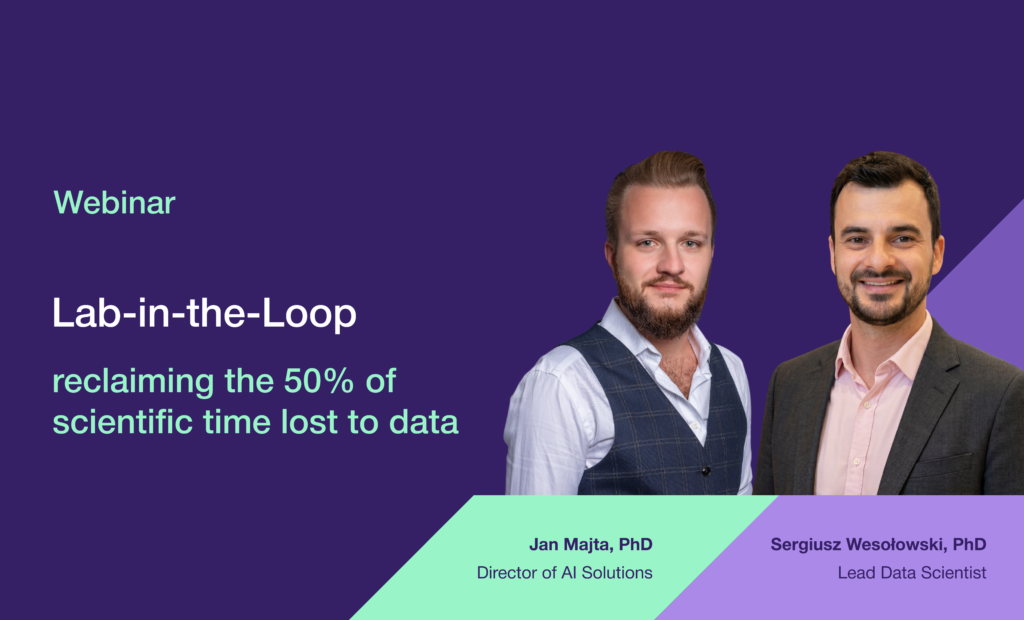
When data lands ready, QC runs in real time, and AI agents participate in the discovery loop itself - research time goes back to science.
49%
3/5
of biopharma scientists’ time spent on manual data work
life science leaders who believe their organization has solved this bottleneck
McKinsey
PhDs are doing data entry. AI pilots stall before they influence decisions. Compounds get nominated from runs that should have been repeated. The hard part was never the models, it is everything that has to happen before and after them: QC, formatting, handoffs between instruments and data systems, and the absence of a closed loop between experiments and inference.
This session looks at what changes when the lab produces AI-ready data by design, and when orchestration agents start operating within that loop rather than sitting at the edge of it.
What you will learn
- Where the 49% actually goes, and which parts are structural versus solvable with today’s infrastructure.
- How agentic AI fits inside the discovery loop: orchestrators, knowledge graphs, and the human-in-the-loop pattern that works at production scale.
- The architecture beneath the iceberg, what scientists see versus what has to exist for a closed-loop lab to function reproducibly.
- Real failure modes: why most lab automation projects do not close the loop, and what separates the ones that do.
Who should attend
- Heads of Computational Biology, Digital R&D, Data Science, and Lab Automation at pharma and biotech organizations.
- Scientists and data architects responsible for turning instrument output into decisions.
- Anyone whose AI pilots have produced interesting POCs that have not made it into regular R&D workflows.
Speakers
Both speakers have built and deployed agentic lab systems inside pharma programs. The session is structured around what they have seen work – and what fails before it reaches production.

Jan Majta, PhD

Sergiusz Wesołowski, PhD
Sergiusz is a Lead Data Scientist at Ardigen specializing in knowledge graphs, graph machine learning, and explainable AI for biomedical applications. He focuses on designing AI-driven systems for semantic data integration, metadata harmonization, and decision support across complex life science workflows. With over a decade of experience spanning pharma, biotech, and startups, his work bridges advanced machine learning with real-world scientific data challenges across genomics, EHRs, and large-scale knowledge systems.