AI-Driven Phenomics in Drug Discovery: From Data to Decision
End to End Data-to-Decision Journey for AI-Driven Phenomics in Drug Discovery
Summary:
- In AI-driven drug discovery, the bottleneck is no longer generating data but making heterogeneous datasets usable, trustworthy, and predictive at scale.
- Ardigen phenAID addresses this challenge through an end-to-end phenomics data journey that connects ingestion, FAIR-compliant curation, multimodal integration, exploratory analytics, and AI modeling to help teams extract reliable insight from cellular imaging and multi-omics data.
- Thanks to our data journey approach, organizations can analyze images 4x faster with 34x lower compute costs. Reduce image storage and processing expenditures by 50%.
- Multimodal integration significantly improves performance (ROC AUC) of bioactivity predictions over single-modality approaches.
Thanks to modern high-throughput technologies such as High-Content Screening, transcriptomics (Drug-Seq), and proteomics, generating data at scale is no longer the primary hurdle. Instead, the challenge lies in extracting meaningful insights and making sense of massive, heterogeneous datasets that surpass the capacity of traditional analytical approaches.
High-Content Screening biologists generate terabytes of data every year. A single-cell image carries substantial biological information, particularly in complex, target-agnostic assays such as Cell Painting. Conventional analysis methods struggle to extract the full depth of information encoded in these images.
Data scientists face the challenge of scaling existing pipelines and integrating image-based profiling with other omics modalities, a process that often makes the transition from wet-lab output to actionable insights long and costly.
The Ardigen phenAID platform is designed to address these bottlenecks by providing a scalable environment for data centralization (AWS/Azure, Snowflake) and FAIR-compliant curation, ensuring your data is AI-ready. By leveraging reproducible, automated analytics pipelines, Ardigen phenAID integrates complex multimodal data to generate deeper biological insights based on robust predictions, significantly reducing both time-to-discovery and computational costs.
The Prize:
- Accelerated Analysis: 4x faster deep-learning image analysis with 34x lower compute costs.
- Operational Efficiency: 50% reduction in image storage and processing expenditures.
- Superior Predictive Power: Multimodal integration significantly improves ROC AUC and bioactivity predictions over single-modality approaches.
- Seamless Integration: An open, modular solution: plug our embeddings and outputs directly into your existing tools and workflows.
That is why an end-to-end platform matters. Without one, the journey from wet-lab output to a usable model can become slow, expensive, and brittle [1]. Our goal is to enable earlier, smarter R&D decisions by turning raw data into a strategic advantage.
Let’s dive deeper into the process from the very beginning.
1. Data Sourcing: The Real-World Data, Not a Perfect Dataset
Most pharmaceutical and biotech programs operate on complex experimental datasets generated over time, often across multiple teams and infrastructure choices. Ardigen phenAID primarily works with client data, including both newly generated and historical datasets, with high-content screening images, especially Cell Painting, as a core modality [2].
However, the platform is not limited to imaging alone. It can work with images, chemical structures, transcriptomics, and proteomics. It is also instrument-agnostic, so it can easily work with any image or other data formats.
That flexibility matters because scientific programs rarely stay inside a single data lane. A rigid system creates friction every time the science expands. A modular one creates continuity.
Importantly, we can combine proprietary datasets with large public resources, such as JUMP-CP, RxRx or ChEMBL datasets, enabling AI models to benefit from large-scale pretraining before being refined using client-specific data. This approach significantly improves model generalization and predictive accuracy.
A platform that accepts real-world experimental heterogeneity lowers the activation energy for AI. Instead of asking the organization to rebuild its science around the tooling, the tooling adapts to the science.
2. Data Storage, Governance and Compliance: Secure and Stable Infrastructure
Large-scale imaging and omics programs quickly become expensive if data storage and computing are poorly organized. Governance is equally important. In regulated or pre-regulated environments, organizations need clear control over where data live, who can access them, how versions are tracked, and how outputs can be audited.
Ardigen phenAID can operate on any client-selected infrastructure, including cloud or on-premises environments, and is built for secure, scalable handling of large data volumes.
The platform is designed to handle large biological datasets while maintaining:
- secure access controls,
- version tracking,
- compliance with internal data governance requirements.
Weak governance creates hidden outlays. An efficient storage architecture reduces image storage and processing costs. Clients who use Ardigen phenAID typically notice a 50% savings.
3. Data Ingestion and Processing: Speed Determines Whether Scale Is an Asset or a Burden
Many AI projects do not meet expectations: not because the models are poor, but because the analysis path is too slow and operationally expensive to support iteration. This is especially true in morphological profiling, where datasets include raw images, single-cell features, derived embeddings, compound annotations, and linked assay metadata.
Ardigen phenAID accelerates this stage using:
- GPU-accelerated computing,
- automated quality control applied to all ingested data,
- elastic compute and auto-scaling.
In certain use cases, these optimizations enable analysis speeds up to 100× faster than traditional pipelines, dramatically reducing the time between experiment and insight [3].
When ingestion and preprocessing are slow, scientists become conservative. They subsample. They delay retraining. They postpone multimodal integration. They avoid re-running analyses after quality corrections.
Speed, by contrast, makes the workflow experimentally conversational. It allows teams to test hypotheses, inspect artifacts, incorporate newly generated data, and revisit model assumptions before project windows close. That is one of the strongest practical arguments for treating ingestion and processing as real strategic capabilities.
4. Data Curation and FAIRification: Standards That Help Datasets Live Longer
Raw experimental datasets rarely arrive in a form suitable for AI modeling. Sensitive drug discovery information often requires anonymization, controlled access, and infrastructure that aligns with internal compliance standards. Ardigen phenAID is ready to work with fully anonymized data.
The FAIR framework is helpful here because it does not require all sensitive data to be openly shared; it emphasizes rich metadata, structured access rules, interoperability, and reuse [1].
High-throughput data are usually generated over long timelines and must be curated through cross-dataset harmonization, including normalization and batch correction, to ensure consistent predictions across massive datasets.
Ardigen phenAID analysis incorporates these steps and ensures adherence to the FAIR standards.
5. Data Accessibility and Exploration: Insight Cannot Be Gated by Coding Skills
A high-value drug discovery dataset is useful only to the extent that biologists and chemists can meaningfully interrogate it. However, not all of them are fluent coders, so exploring complex datasets requires data scientists’ facilitation.
This hurts both organizationally and scientifically. When data remains locked, iteration slows, and domain insight gets stuck. When bench scientists and subject-matter experts can inspect patterns directly, discussions become sharper, QC issues surface earlier, and modeling decisions are more closely linked to biological reasoning.
That is why we treat data exploration as a collaborative scientific area that should no longer be a technical privilege. Ardigen phenAID provides a user-friendly interface that allows biologists, chemists, and toxicologists to explore images and linked data without relying on computational teams for every inspection step.
Users can explore:
- cellular images and phenotypic signatures,
- compound annotations and metadata,
- clustering patterns across perturbations,
- relationships between chemical structures and phenotypes.
Ardigen’s public JUMP-CP Data Explorer exemplifies our philosophy. It allows users to explore the large Cell Painting dataset through an intuitive interface and to examine phenotypic and structural representations without building a bespoke navigation stack. We will discuss it more in the next section.
6. Exploratory Analysis: Where Hidden Defects and Opportunities Reveal
Exploratory analysis is often treated as the prelude to “real” modeling. This part of the analysis workflow is critical for high-content datasets, which frequently contain subtle technical artifacts that can compromise downstream modeling.
Ardigen phenAID uses its proprietary quality control approach to identify data issues that conventional QC tools typically miss. The QC outcome can be easily explored through plate map visualizations and poor-quality data are removed from downstream analysis, improving prediction quality.
The platform applies an anomaly-detection approach to identify perturbations (e.g., small molecules or genetic perturbations) that induce morphological changes in the examined cells. The scientist can immediately see biological activity and focus on these cases.
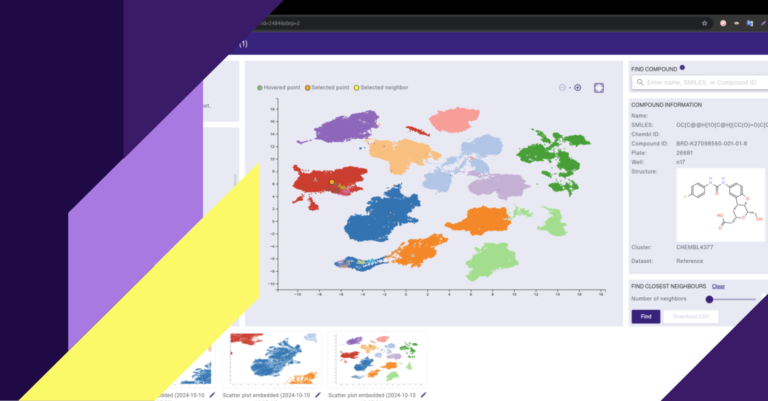
Users can further explore the data and uncover morphological or structural similarities using unsupervised clustering and UMAP visualizations across various data embeddings. Ardigen phenAID JUMP-CP Explorer, an open-source application designed to facilitate exploration of the JUMP-CP dataset, offers a preview of what the user can accomplish.
Once datasets are curated and validated, they can be used to train machine learning models that support multiple drug discovery tasks.

Fig. 1. Ardigen phenAID JUMP-CP Data Explorer interface.
7. AI Training and Modeling: Multimodal, Iterative and Biologically Grounded
Early characterization of drug candidates is crucial for the project’s success. Late-stage discovery of toxicity, lack of efficacy, or poor developability is expensive, while failure to recognize a promising candidate at the very beginning can mean losing an opportunity to develop a novel therapy.
Morphological profiling offers a compelling approach to characterizing drug candidates early. It is scalable and relatively cost-efficient, so it is easily applied at the early stage of drug discovery projects.
Morphological profiling, also called phenomics, can support biological activity or toxicity prediction, high-quality hit identification from phenotypic screening, virtual screening, lead optimization, or de novo compound design.
Ardigen phenAID uses proprietary AI algorithms to address all of the above. We apply the latest advancements in Computer Vision, AI-cheminformatics and bioinformatics to provide high-quality predictions that allow generating biological insight for drug discovery projects. Our models are pre-trained on public data, so training models on proprietary data is faster.
Just as important, the platform is not limited to single-modality learning. It can also work with other data modalities. Introducing modalities beyond cellular imaging improves predictive power and lowers the risk of overfitting.
Furthermore, models are easily scalable. They can be retrained in the application as new data arrives. That is the modern architecture for R&D programs, where learning should not be frozen after the first model release. It should compound.
We also perform custom analysis and train models for new modalities or types of high-content screening data (e.g., other stainings than Cell Painting).
8. Automated Insights and Discovery: Translating Data Engineering Into Business Value
In one recent case study, our biological property prediction models, trained on client-specific data, increased the number of high-quality predictions (ROC AUC > 0.8) by 30%.
This has significantly accelerated the workflow across multiple drug discovery projects. These models are continually retrained on new experimental data, enabling predictions to improve over time. Beyond property and MoA (Mechanism of Action) prediction, we also provide modules for Virtual Screening and Hit Identification, as well as bespoke modules tailored to client needs.
This iterative learning process transforms phenomics data from static experimental outputs into a continuously evolving discovery resource.
Final results of AI analysis outcome can be easily explored through Ardigen phenAID visualizations and shared with other team members or across the organization.
What would have required two weeks of manual work can now be done in a couple of days. You can perform an end-to-end analysis from raw data ingestion to the automated reporting of results. We believe our model is truly transformative at an operational level.
Metric | Impact |
|---|---|
ROC AUC | >0.8 |
Cost reduction | 4x lower |
Ingestion speed | 100x faster |
QC | detection of unspecific quality issues |
Table 1. Key performance metrics of the Ardigen phenAID platform – from predictive accuracy to processing speed.
The Future of the Data Journey
For scientific leaders, the appeal of AI in drug discovery is obvious. The risk is equally obvious: investing in modeling before the underlying data journey can support it.
Thoughtful data management produces measurable business value: faster prioritization, better candidate triage, reduced computational overhead, and fewer lost days between experiment and decision.
The Ardigen phenAID platform addresses the chain of dependencies that enables high-quality analysis. It supports multimodal data sourcing, scalable storage, accelerated ingestion, QC, harmonization, FAIRification, interactive exploration, and retrainable AI workflows within a single connected environment.
Ardigen phenAID continues to evolve through model retraining and the addition of new modalities, with particular interest in applying phenomics and multi-omics to earlier toxicity prediction. We are seeking partners who want to further develop this approach. The teams that want to not just analyze faster. They would like to learn faster.
Accelerate Your AI Discovery. Let’s Talk About How to Apply Ardigen phenAID
Author: Martyna Piotrowska
Technical editing: Ardigen expert: Magdalena Otrocka, PhD
Bibliography
- Wilkinson MD, Dumontier M, Aalbersberg IJ, et al. The FAIR Guiding Principles for scientific data management and stewardship. Sci Data. 2016;3:160018. https://doi.org/10.1038/sdata.2016.18
- Ardigen. Ardigen phenAID platform overview [Internet]. [Cited 2026 Mar 13]. [Available from:] https://ai.ardigen.com/ardigen-phenaid
- Kupś I, et al. From Public Repositories to Target Hypotheses – An End-to-End Data-to-Insights Journey for scRNA and Spatial Omics with Knowledge Graphs [Poster]. Festival of Genomics and Biodata, London. 2026 [Cited 2026 Mar 13]. [Available from:] https://ardigen.com/poster-from-public-repositories-to-target-hypotheses/
- Pruteanu LL, Bender A. Using transcriptomics and cell morphology data in drug discovery: the long road to practice. ACS Med Chem Lett. 2023;14 (4): 386-395. https://doi.org/10.1021/acsmedchemlett.3c00015
- JUMP Cell Painting dataset. Broad Institute [Internet]. [Cited 2026 Mar 13]. [Available from:] https://jump-cellpainting.broadinstitute.org