
Target Identification and Validation Services for Drug Discovery
Combine omics, literature, patient and experimental data to prioritize targets, assess druggability and guide validation decisions.
Identify the targets worth validating
Target identification in drug discovery is not only a search problem. The harder decision is which biological hypotheses are strong enough, specific enough and actionable enough to justify the next experiment. Ardigen combines multimodal evidence and AI-supported analysis to move from a broad target space to a prioritized, reviewable set of therapeutic hypotheses.
Why target programs stall
Target programs often slow down because evidence is fragmented across modalities, disease context is missing, and ranking methods compress complex biology into scores that are difficult to defend. A useful target identification workflow should make the evidence visible, preserve uncertainty and show what still needs to be validated.
Disconnected evidence.
Genetics, omics, literature, phenotypic data and internal experiments may point in different directions or live in separate systems.
Single-modality bias
A target can appear strong in one dataset and weaken when tissue, cell-type or pathway context is considered.
Black-box prioritization
A ranked list is hard to use when scientists cannot trace the drivers behind each score.
Validation gaps
Druggability, off-target liabilities and the experimental model are often addressed too late.
Weak handoff
Computational results are most useful when they end in clear validation hypotheses and next experiments.
From biological question to validation-ready target hypotheses
Ardigen structures target discovery around the scientific decision, the evidence available and the validation path required by the program.
Biological Question
Data Exploration
Target Predictions
Target Assessment
Validation
Discover and prioritize therapeutic targets
Discover and prioritize therapeutic targets. Integrate program-relevant evidence to identify candidate targets associated with the disease mechanism and suitable for further assessment.
Understand target function in disease context
Examine pathways, tissue and cell-type context, perturbation evidence and known biology to understand how the target may influence disease progression.
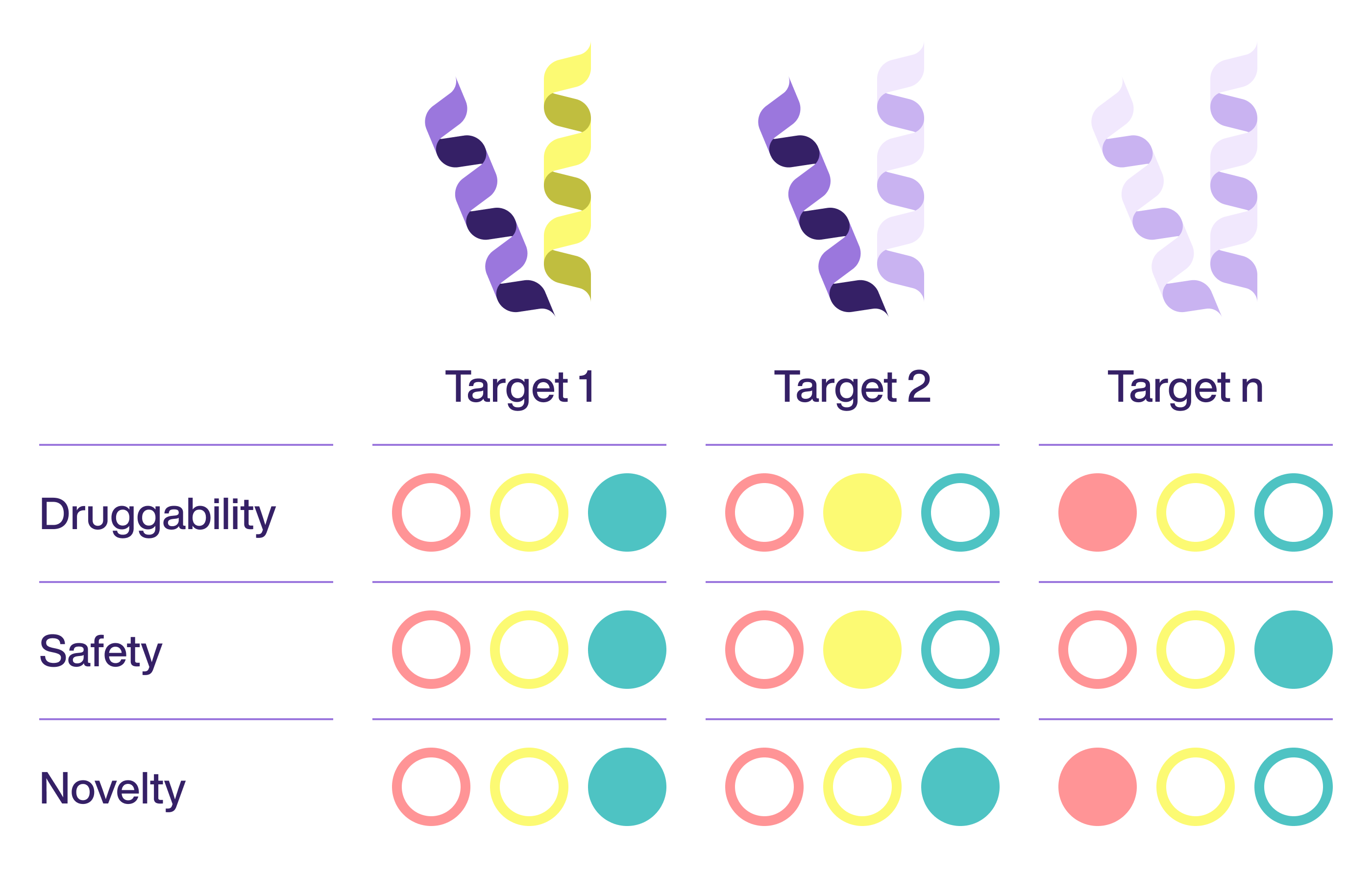
Assess druggability and off-target risk
Evaluate structural, functional and network-level evidence to identify potential opportunities, liabilities and unanswered questions before experimental commitment.
Select the validation model
Use the biology of the target and disease to guide the choice of in vitro or other preclinical models that can test the most important assumptions.
Define the validation path
Turn the computational evidence into a target dossier, decision rationale and proposed validation steps. Experimental work can be performed by the client or through an agreed partner model, depending on scope.
Discuss your target identification and validation program

Target identification and validation capabilities

Target discovery and evidence-weighted prioritization
Combine multimodal data and biological knowledge to rank candidate targets according to program-specific criteria rather than a generic score.

Target validation
Assess target relevance, druggability, functional evidence and potential liabilities, then define what must be tested experimentally before the target advances.

Target deconvolution
Investigate which molecular targets may explain an observed phenotype or compound effect and connect candidate mechanisms to supporting evidence.

Indication expansion
Use target biology, pathways, disease associations and available program evidence to explore where an existing target may have additional therapeutic relevance.
Make every target ranking reviewable
For each prioritized target, the goal is not only to produce a score. The analysis should show which evidence supports the hypothesis, what contradicts it, how the disease context affects the ranking and which uncertainties still require validation. This makes AI-supported target prioritization easier to review, compare and hand over to experimental teams.
Typical evidence that may be integrated

Genomics and genetic association data
Transcriptomics and single-cell data
Proteomics and pathway-level evidence
Scientific literature and public reference sources
Proprietary experimental and program data
Clinical or patient-derived evidence when available and appropriate
Phenotypic and perturbation data where relevant
Typical deliverables
Prioritized target shortlist with program-specific scoring criteria
Per-target evidence summary and traceable rationale
Disease, tissue, cell-type and pathway context
Druggability and potential off-target assessment where supported by available evidence
Validation hypotheses and recommended next analyses or experiments
Reproducible analysis outputs or workflows agreed for the engagement
What changes for your team
Prioritize with context
Compare targets using the evidence that matters for the disease and program, not a one-size-fits-all ranking.
Review the reasoning
Keep the evidence, assumptions and uncertainty visible so scientists can challenge and refine the result.
Move into validation with a clearer plan
Translate computational findings into specific questions, decision gates and the next experimental step.
Real-world impact
Case studies



Frequently Asked Questions
What is target identification and validation in drug discovery?
Target identification finds biological molecules or pathways that may be relevant to a disease mechanism. Target validation tests whether a candidate target is sufficiently linked to the disease, actionable and suitable for therapeutic intervention. In practice, the two stages should connect: prioritization should already account for the evidence that will matter during validation.
How does AI improve therapeutic target identification?
AI can help integrate and compare evidence across genomics, transcriptomics, proteomics, literature, phenotypic data and other program-relevant sources. The value is highest when the method preserves disease context and makes the reasons behind each target ranking reviewable by scientists.
Can AI validate novel biological targets?
AI can strengthen target validation by assessing evidence consistency, disease relevance, druggability, potential liabilities and the experiments needed to test key assumptions. It does not replace experimental validation; it helps focus it on the most decision-relevant questions.
How do you assess druggability and potential off-target effects?
The approach depends on target class, available structural and functional information, biological networks and the intended therapeutic modality. Computational assessment can highlight opportunities and liabilities, but conclusions should be interpreted within the available evidence and confirmed through appropriate experiments.
What data can be used for target identification and prioritization?
Depending on the program, the evidence base can include genetic associations, bulk and single-cell omics, proteomics, pathway data, perturbation or phenotypic evidence, literature, public reference resources and proprietary experimental data. The exact mix is defined by the biological question and data quality.
What do we receive from a target identification engagement?
Typical outputs can include a prioritized target shortlist, per-target evidence summaries, scoring rationale, disease-context analysis, druggability or liability assessment where appropriate, and a recommended validation path. The final deliverables are agreed around the client’s next decision and internal workflow.
Can Ardigen work with our existing target list and internal data?
Yes. The engagement can start from an existing candidate list, internal evidence or a broader disease question. Ardigen can combine approved proprietary data with relevant external sources and adapt the analysis to the review process already used by the scientific team.
Contact
Ready to discuss a target program?
Tell us the scientific project area, available evidence, current target set and the decision your team needs to make. We will review the scope and propose a practical next step.
Newsletter
Become an insider
Be the first to know about Ardigen’s latest news and get access to our publications, webinars and more!