Next-Generation Tools in Drug Discovery
Key takeaways
- Traditional workflows rely on isolated datasets and static modeling, leading to inefficient hypothesis testing and costly failures.
- AI-driven systems address this, supporting binding affinity prediction and causal target prioritization, while generative models design novel proteins with non-natural properties.
- Closed-loop self-driving labs combine robotic automation with Bayesian optimization, reducing experimental cycles from weeks to minutes, and structure prediction models achieve up to 40% performance gains with 1,000× speed improvements over traditional methods.
- The result: a transition to predictive, system-level drug discovery that compresses preclinical timelines from ~4 years to 18 months while improving the probability of clinical success.
The pharmaceutical industry has long operated under the shadow of a pessimistic statistic: a 92% failure rate [1]. For decades, the process from initial discovery to the patient’s bedside has been plagued by unpredicted toxicities and inadequate efficacy revealed after billions have been spent. This productivity gap results from a traditional empirical trial-and-error model. A hypothesis-driven but ultimately hit-or-miss methodology.
Today, we are witnessing a structural realignment. The industry escapes from serendipitous screening to a data-centric, predictive paradigm. By early 2026, the emergence of AI-driven drug discovery platforms has begun to transform the ontology of biological targets, replacing old-school discovery with systematic simulation.
The End of Static Folding: Boltz-2 and the Binding Revolution
While the early 2020s were defined by the folding revolution, in which tools like AlphaFold predicted 3D structures in isolation, the focus has moved to the messy, crowded reality of the cell. Now, we are interested in how the protein interacts with other macromolecules and small-molecule ligands in a dynamic biological environment.
The 2025 generation of structure prediction tools has solved many of the problems that remained open following the initial release of AlphaFold 2. New models prioritize predicting the drug-target binding affinity with high precision. Leading this charge is Pearl (Genesis Molecular AI/NVIDIA), which applies scaling laws to chemical-biological interactions to achieve a 40% improvement over AlphaFold 3 on key drug discovery benchmarks [2].
Simultaneously, the democratization of high-accuracy structure prediction has been facilitated by the OpenFold Consortium. In October 2025, the release of OpenFold3 provided an open-source alternative that approached parity with AlphaFold 3, ensuring that even smaller biotechnology firms and academic labs could access state-of-the-art modeling tools without proprietary constraints [2].
The emergence of Boltz-2 (MIT/Recursion) represents a significant leap in efficiency. By June 2025, Boltz-2 demonstrated quantitative estimates of binding affinity with near physics-level accuracy. Crucially, it operates at speeds 1,000x faster than traditional Free Energy Perturbation (FEP) methods [2, 3]. These virtual screening tools and Generative AI for molecule optimization allow researchers to evaluate billions of compounds in the time it once took to screen thousands.
Tool Name | Developer | Core Technology | Key 2025 Achievement |
|---|---|---|---|
Pearl | Genesis Molecular AI | Scaling-law Molecular AI | 40% gain over AlphaFold 3 in binding benchmarks |
Boltz-2 | MIT CSAIL / Recursion | Billion-parameter Generative Model | Predicted structure/binding 1,000x faster than FEP |
OpenFold3 | OpenFold Consortium | Transformer-based Open Source | Reached parity with proprietary AF3 |
DragonFold | CHARM Therapeutics | 3D Deep Learning | Atomic-level 3D protein-ligand prediction |
RFdiffusion3 | David Baker Lab | Diffusion Model | 10x faster performance with atom-level precision |
Tab. 1. Key leading AI tools in drug discovery
Beyond Nature’s Templates: ESM3 and De Novo Protein Design
Evolution optimizes proteins for biological survival, often missing the highly stable or specific configurations required for human medicine. Generative AI is now fixing this ‘evolutionary myopia’ by creating bespoke proteins that have never existed in nature.
Models like ESM3 (98 billion parameters) and ProGen3 (46 billion parameters) act as AI research assistants for biotech, designing novel proteins by sampling the existing ones. A landmark example is esmGFP, a fluorescent protein generated by ESM3 that is only 58% identical to any natural counterpart [4]. To ensure these creations are chemically valid and handle molecular chirality, researchers use representations such as SELFIES and SAFE (Sequential Attachment-based Fragment Embedding).
The development of NovoChromes – artificial protein catalysts that use synthetic porphyrins to catalyze non-natural reactions, such as silylation – shows that we can now design molecular building blocks with high thermal resistance (Tm > 90°C) and solvent stability that nature never intended [5].
The Rise of the Agentic Lab: Self-Driving Research Ecosystems
The laboratories use agents with Self-Driving Labs (SDLs). These systems integrate robotic hardware with AI ‘brains’ to create closed-loop experimentation cycles where the computer generates a hypothesis, designs the experiment, executes it via robotics, analyzes the results, and refines the hypothesis for the next round.
Key frameworks for these autonomous systems include:
- AI Co-Scientist (Google DeepMind), built on Gemini 2.0, can replicate a decade of research in 48 hours, independently generating hypotheses and designing complex validation experiments.
- The AI Scientist (Sakana AI) executes the full research cycle, from idea generation to drafting scientific papers.
- BayBE, the Bayesian optimization framework, serves as the decision-making core, guiding automated equipment.
The results are staggering. At Novo Nordisk, the use of Claude for Life Sciences integrated with lab platforms such as Benchling reduced clinical documentation timelines from 10 weeks to 10 minutes [2]. Through self-service bioinformatics pipelines and automated metadata annotation tools, labs are eliminating the data silos that historically choked innovation.
The Clinical Trial in a Dish: Organ-on-a-Chip and iPSC Technology
The FDA Modernization Act 2.0 has catalyzed a move away from animal models toward human-relevant biology. Researchers use induced pluripotent stem cells (iPSCs) derived from patients to create Organ-on-a-Chip (OOC) systems that serve as clinical trials in a lab dish.
Companies like Emulate and MIMETAS have moved beyond simple models. For example, the Duodenum Organ-Chip has been shown to produce the most mature, functionally relevant intestinal phenotype available, far outperforming traditional 2D cultures or organoids [6]. Other breakthroughs include the ALS spinal cord chip, which captures the neurofilament dysregulation and synaptic signaling defects of sporadic ALS, impossible to replicate in mice [6].
These advancements power the phenotypic drug discovery software and image analysis for phenotypic profiling, such as Ardigen phenAID. By using digital twins and virtual control-arm predictions, built on phenotypic data from Organs-On-the-Chip, drug developers can now predict how a specific patient population will respond to a drug before a single human is dosed.
Population-Scale Proteomics: Olink and the Search for Causality
High-throughput proteomics revolutionizes target identification. Platforms like Olink Explore HT and Seer Proteograph ONE move the industry from correlation to causality.
The UK Biobank’s analysis of 5,400 proteins across 600,000 samples with Olink has linked proteomic data with genomic records to identify protein quantitative trait loci [7]. This allows researchers to prioritize targets with a high probability of clinical success by proving they actually drive the disease.
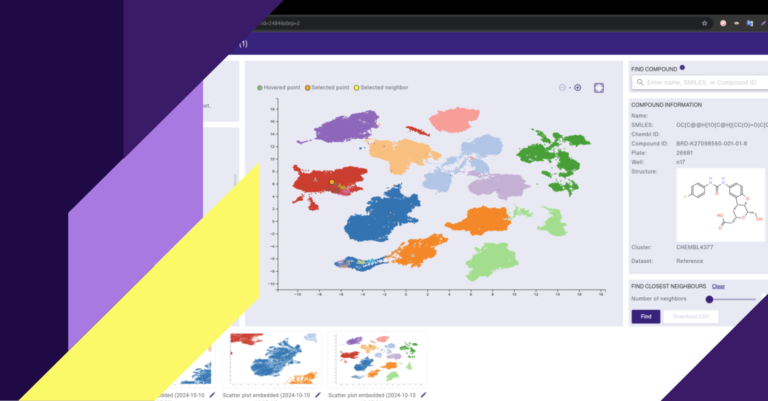
Utilizing the single-cell atlas browser, scientific data visualization apps, and automated assay analysis software, scientists can now see the full proteomic picture with unprecedented clarity.
The Quantum Inflection Point: Hybrid Simulations and KRAS
The year 2025 marks the inflection point where quantum-classical hybrid workflows became essential for subatomic precision. While classical computers struggle with protein hydration analysis, quantum processors handle it with ease.
Insilico Medicine demonstrated this power by targeting KRAS, a notoriously ‘undruggable’ cancer target. Their quantum-enhanced pipeline used quantum circuit Born machines (QCBMs) to refine a pool of 100 million molecules down to 15 promising candidates, two of which showed real biological activity and high binding affinity [8].
Furthermore, quantum algorithms have been successfully used for protein hydration and ligand-binding analysis with higher precision than classical methods [9]. This is vital because water molecules often mediate binding between a drug and its target, and inaccurate placement can lead to a candidate’s failure in later testing.
Quantum computing is no longer a distant promise; the tools for the subatomic interactions have become a reality in drug discovery.
Conclusion: The Definitive Test
The integration of Retrieval Augmented Generation (RAG) for scientific search and digital pathology AI tools has successfully compressed the preclinical phase from four years to 18 months. However, the definitive test arrives in 2026, as the first wave of fully AI-designed programs enters pivotal human trials.
To bridge the remaining ‘Valley of Death,’ the FDA’s January 6, 2025, draft guidance provides a roadmap for AI validation, featuring a 7-step credibility assessment focused on transparency and maintenance.
As we move forward, the strategic question is whether these tools will fundamentally increase the probability of clinical success or simply allow the industry to fail faster and more expensively than ever before. The next twelve months will provide the answer.
Frequently Asked Questions
What are the most impactful AI tools in drug discovery today?
The most impactful tools include structure-based AI models for binding prediction, generative models for de novo protein design, self-driving laboratories (SDLs), organ-on-chip systems, and multimodal data platforms. Together, they enable end-to-end workflows from target identification to experimental validation, integrating omics, chemical, and phenotypic data.
How does AI improve drug discovery success rates?
AI improves success rates by enabling earlier and more accurate target validation, mechanism-of-action (MoA) prediction, and toxicity assessment. By combining multimodal data and knowledge graphs, AI reduces reliance on trial-and-error approaches and helps prioritize candidates with higher clinical relevance.
What is binding affinity prediction and why does it matter?
Binding affinity prediction estimates the strength of interaction between a drug candidate and its biological target. Modern AI models can predict these interactions with near physics-level accuracy, improving hit selection and reducing downstream failure rates.
How do self-driving labs (SDLs) work?
Self-driving labs integrate AI models, robotic automation, and Bayesian optimization into closed-loop systems. They autonomously generate hypotheses, run experiments, analyze results, and refine future experiments, significantly accelerating research cycles.
What is multimodal data integration in drug discovery?
Multimodal integration combines diverse datasets such as genomics, proteomics, chemical structures, and imaging data. AI models use this integrated view to uncover complex biological relationships, improving target identification and patient stratification.
How do organ-on-a-chip systems replace animal testing?
Organ-on-chip systems use human-derived cells, often from iPSCs, to replicate organ-level physiology in vitro. These systems provide more clinically relevant data than animal models and enable early prediction of drug efficacy and toxicity.
What role does proteomics play in AI-driven drug discovery?
High-throughput proteomics enables causal target identification by linking protein expression to disease phenotypes. When combined with genomic data and AI models, it supports more robust biomarker discovery and MoA validation.
How is generative AI used to design new drugs?
Generative AI models create novel molecules and proteins by learning patterns from existing biological and chemical data. These models can design candidates with optimized properties, such as stability, specificity, and manufacturability.
What is the role of knowledge graphs and graph neural networks?
Knowledge graphs organize biological entities and relationships into structured networks. Graph neural networks (GNNs) analyze these networks to identify hidden connections, predict drug-target interactions, and support causal inference.
Can AI reduce drug discovery timelines?
Yes. AI-driven pipelines can compress preclinical timelines from approximately 4 years to 18 months by accelerating data analysis, hypothesis generation, and experimental validation.
What is quantum computing’s role in drug discovery?
Quantum-classical hybrid models improve the simulation of molecular interactions at subatomic precision. They are particularly useful for modeling protein hydration and ligand binding, which are difficult to model in classical systems.
Will AI replace scientists in drug discovery?
No. AI augments human expertise by automating repetitive tasks and enabling more in-depth analysis. Scientists remain essential for hypothesis framing, interpretation, and decision-making, especially in complex biological systems.
Author: Martyna Piotrowska
References
- Yildirim Z, Swanson K, Wu X, Zou J, Wu J. Next-Gen Therapeutics: Pioneering Drug Discovery with iPSCs, Genomics, AI, and Clinical Trials in a Dish. Annu Rev Pharmacol Toxicol. 2025 Jan;65(1):71-90. https://doi.org/10.1146/annurev-pharmtox-022724-095035
- Buntz B, 6 ways AI reshaped scientific software in 2025 [Internet]. Rdworldonline.com. 2025 Dec 16 [cited 2026 Mar 25]. Available from: https://www.rdworldonline.com/6-ways-ai-reshaped-scientific-software-in-2025/
- Laurent A. AI applications in the drug development pipeline [Internet]. IntuitionLabs. 2025 [cited 2026 Mar 25]. Available from: https://intuitionlabs.ai/articles/ai-drug-development-pipeline
- Wikipedia contributors. EsmGFP [Internet]. Wikipedia, The Free Encyclopedia. 2026. Available from: https://en.wikipedia.org/w/index.php?title=EsmGFP&oldid=1334886875
- Hou K et al. De novo design of porphyrin-containing proteins as efficient and stereoselective catalysts. Science. 2025 May;388: 665-670. [cited 2026 Mar 25]. Available from: https://doi.org/10.1126/science.adt7268
- Emulatebio. A Pivotal Year for NAMs and the Top 10 Organ-Chip Publications Supporting Their Adoption. 2026 [cited 2026 Mar 25]. Available from: https://emulatebio.com/2025-a-pivotal-year-for-nams-and-the-top-10-organ-chip-publications-supporting-their-adoption/
- Sun BB, Chiou J, Traylor M et al. Plasma proteomic associations with genetics and health in the UK Biobank. Nature. 2023;622: 329-338. Available from: https://doi.org/10.1038/s41586-023-06592-6
- Philippidis A. Insilico, U. Toronto Researchers Develop Quantum-Classical Computing AI Model [Internet]. Genengnews.com. 2025 [cited 2026 Mar 25]. Available from: https://www.genengnews.com/topics/artificial-intelligence/insilico-u-toronto-researchers-develop-quantum-classical-computing-ai-model/
- Reymond G-O. How quantum computing is changing molecular drug development [Internet]. World Economic Forum. 2025 [cited 2026 Mar 25]. Available from: https://www.weforum.org/stories/2025/01/quantum-computing-drug-development/