From cell imaging to better hit prioritization
Turning complex phenotypic data into actionable discovery decisions
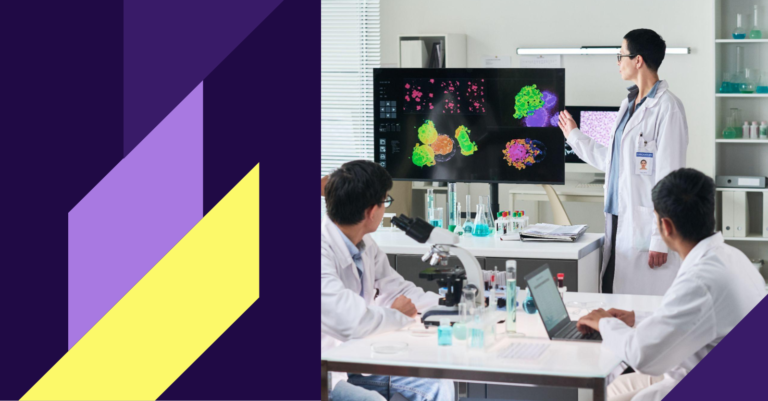
Phenotypic screening can generate rich biological signals, but large imaging datasets and unclear mechanisms can make those signals difficult to translate into compound decisions.
Ardigen built an end-to-end workflow combining cell imaging, multi-omics, data infrastructure and AI modeling to improve bioactivity prediction, enable phenotypic-based virtual screening and support confident hit identification and prioritization for downstream lead validation.
Challenge
Phenotypic signals were difficult to turn into decisions
The project addressed three connected challenges:
- Hits without a mechanism, contributing to slow SAR cycles.
- Phenotypic signals that were difficult to translate into decisions.
- Imaging data too large to process at discovery speed.
At the same time, the broader workflow needed to handle large-volume data, support harmonization across datasets and make imaging and multimodal information accessible for analysis.
The goal was to move from large and complex phenotypic datasets toward more reliable bioactivity predictions and better-informed hit prioritization.
Approach
An end-to-end phenotypic data journey
Ardigen created a workflow spanning data sourcing, scalable infrastructure, data curation, exploratory analysis and AI modeling through to automated discovery insights.
1. Build a scalable foundation for imaging data
The workflow incorporated:
- optimized cloud or on-premise storage
- secure and scalable infrastructure
- GPU-accelerated processing
- elastic compute and auto-scaling
- automatic quality control
This enabled large imaging datasets to be processed more efficiently and prepared for downstream analysis.
2. Prepare an AI-ready phenotypic data product
Data curation included:
- data anonymization
- logging and auditability
- cross-dataset harmonization
- normalization
- batch correction
The resulting AI-ready Phenotypic Data Product provided a structured foundation for subsequent exploration and modeling.
3. Enable multimodal data exploration
Researchers were provided with capabilities for:
- multimodal data exploration
- interactive image viewing
- graphical user interface access
- custom quality control
- unsupervised clustering
- anomaly detection
This also helped identify unexpected quality issues in multiple datasets before those issues propagated into downstream analysis.
4. Apply AI models to prediction and discovery
The modeling stage included:
- custom AI models for modality representation and prediction
- model retraining and versioning
- high-quality predictions and visualizations
- bioactivity prediction
- virtual screening
- hit identification
- generative AI models
For small-molecule bioactivity prediction, the case study specifically states that HCS and structural data were used.

Results
To-the-point results
30% improvement in the number of high-quality predictions ROC AUC > 0.8
50% reduction in image storage and processing costs
100×+ faster analysis through GPU and custom optimizations
Unexpected quality issues detected across multiple datasets
2–6 months implementation timeline
The resulting workflow supported confident hit identification and prioritization for downstream lead validation.
From phenotypic data to a discovery decision
The project connected multiple stages that are often treated separately.
Source and organize the data
Proprietary client data and public datasets could be brought into a scalable environment.
Make imaging data AI-ready
Processing, quality control, harmonization and FAIRification prepared the data for analysis.
Explore phenotype and multimodal signals
Interactive tools, clustering and anomaly detection helped researchers inspect data and identify relevant patterns.
Model biological activity
Custom AI models supported representation learning, prediction and bioactivity analysis.
Prioritize the next step
The resulting insights supported virtual screening, hit identification and downstream lead validation.
Have a protein target but no obvious binder starting point?
Further reading from Ardigen’s Knowledge Hub
Phenotypic profiling with Ardigen phenAID
Explore Ardigen’s broader capabilities in target characterization, binder generation, hit screening and lead optimization.- End-to-end data-to-decision journey for AI-driven phenomics
See how Ardigen approaches the full phenomics data journey from data preparation and multimodal integration to AI modeling and scientific decisions.
- Multimodal AI for MoA and Bioactivity Prediction
Explore Ardigen’s work combining high-content screening data with complementary modalities to improve biological-property prediction.
High-Content Screening with AI and Machine Learning
Read more about the role of AI and multimodal analysis in extracting information from complex high-content screening datasets.