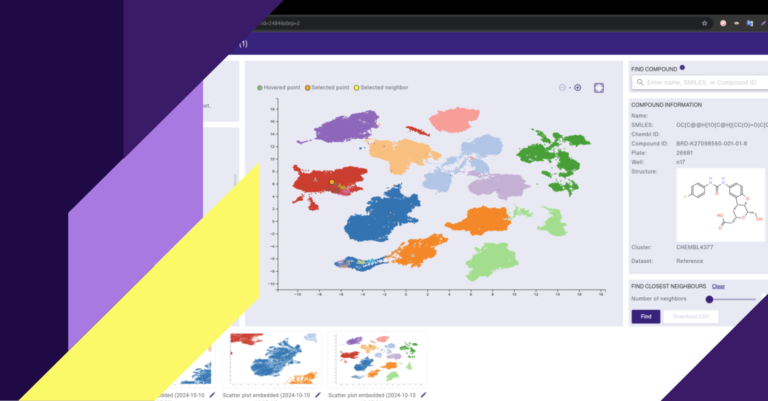
In a pilot project with Merck, we applied the Ardigen phenAID platform to analyze one of their proprietary HSC datasets. The analysis consisted of two tasks: mode of action and bioactivity properties prediction. For each task, we assessed performance using one modality (image or chemical structures features) or multimodal approach (image and chemical structure features) with both human-defined and AI-based features.
For each input modality, we trained two models: one for MoA and one for bioactivity properties prediction. We compared AI-based features (extracted with image and molecule representation models) with human-defined descriptors (CellProfiler and ECFP for images and structures respectively). For both methods, we assessed the confidence of the predictive scores when using only one modality versus multimodal approaches.
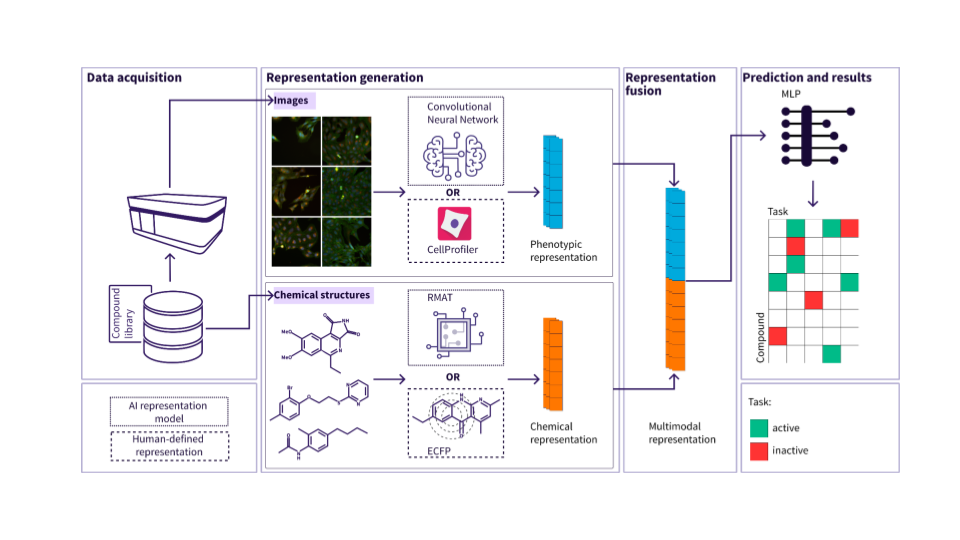
Figure 1. Method overview: Images and structures are processed using either AI model or human-defined features and passed through MLP to obtain predictions.
The multimodal approach consistently improved the prediction scores across all tested setups. It enhanced both the Mode of Action and bioactivity property prediction on a diverse set of biological tasks (Table 1).
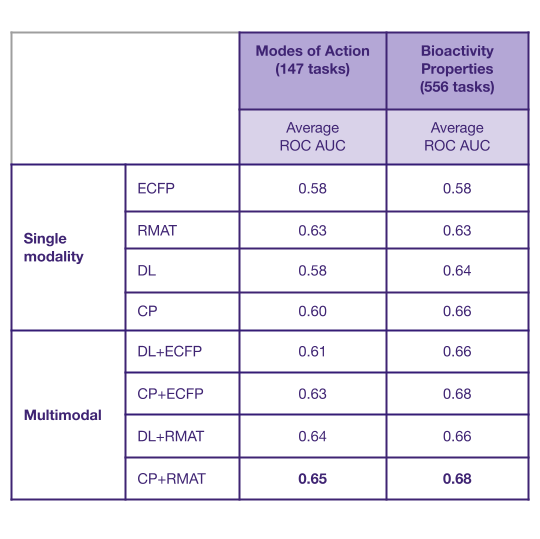
Table 1: A numerical comparison between modalities using ROC AUC scores. For AI-driven modalities, phenotypic representations were generated using a Deep Convolutional Neural Network (GapNet2) pre-trained using a compound-matching task (DL) and representations of chemical structures generated using a proprietary Relative Molecule Attention Transformer (RMAT3) model. Human-defined modalities were obtained using CellProfiler (CP1) for morphological features and Extended-Connectivity Fingerprints (ECFP4) for chemical structures. Bold values represent the best result.
Incorporating machine learning and AI solutions for extracting phenotypic features streamlines drug discovery efforts, reducing both the cost and time of analysis. Using deep learning and AI models, we could extract features faster and cheaper while retaining the prediction performance.
Through this study, we have demonstrated that multimodal approaches increase the confidence of predictions when it comes to HSC data analysis. By combining phenotypic features extracted from the images with chemical structures of the active molecules, we were able to enhance Mode of Action and bioactivity prediction for dozens of compounds tested by Merck KGaA.
To learn more about the results of this study, download our poster.
You can learn more about the phenAID platform here.
Further Reading from Ardigen’s Knowledge Hub
Explore more innovations in High Content Screening, AI, and phenotypic drug discovery: